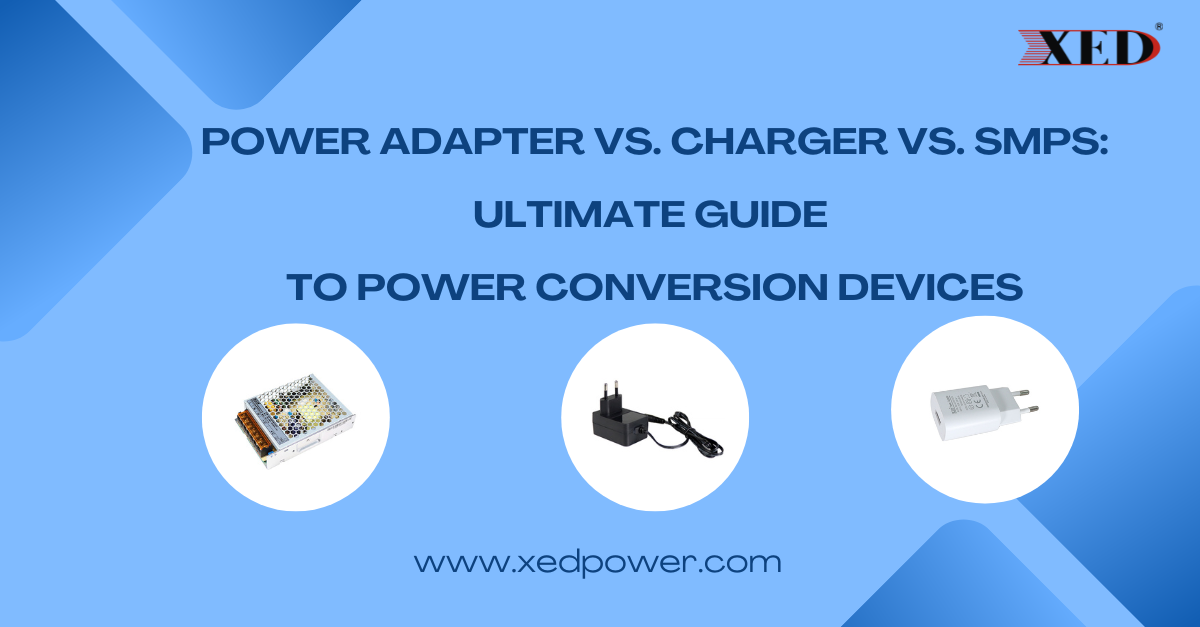
Power Adapter vs. Charger vs. SMPS: Ultimate Guide to Power Conversion Devices
In our daily lives, electronic devices like mobile phones and laptops have become an integral part of our work and entertainment. While the chargers that power these devices are commonplace, the underlying technology and classifications are often overlooked. Many people may not realize that the term "charger" is just one of many power supplies. It's closely related to, but also distinct from, terms like "power adapter" and "switching power supply." This article will explain the definitions, functions, and practical applications of these three, helping you gain a clearer understanding of these gadgets that silently underpin modern life.
1. What is a switching power supply?
A switching mode power supply (SMPS), also known as an alternating current power supply or switching converter, is a high-frequency power conversion device. It is a type of power supply whose primary function is to convert a voltage level into the stable voltage or current required by a device through high-frequency switching technology. Its input can be either AC (such as from a household outlet) or DC, and its output is typically DC. It is suitable for personal computers, industrial equipment, and many household appliances. Switching power supplies are widely used in modern electronic devices due to their high efficiency, compact size, and strong stability.
In summary, the switching power supply is a basic and important power conversion structure that is widely embedded in various power systems and silently undertakes the tasks of voltage conversion and stabilization.
2. The role and composition of the power adapter
A power adapter is a common power converter for small portable electronic devices. It typically consists of a housing, transformer, inductor, capacitor, control IC, and printed circuit board (PCB). Its primary function is to convert AC input into DC output. Depending on the connection method, it can be categorized as either a wall-mounted or desktop type. Power adapters are widely used in routers, set-top boxes, surveillance cameras, LED light strips, and smart home devices. They not only provide power for device operation but can also charge built-in batteries in certain situations.
In short, as a power interface device, the power adapter has the functions of voltage transformation, rectification and power supply, and is an important bridge connecting the power grid and terminal electronic products.
3. Definition and function of charger
A charger is a device specifically designed to replenish energy in rechargeable batteries. Essentially, it converts alternating current (AC) into low-voltage direct current (DC). Built-in control circuitry implements charging strategies such as current and voltage limiting to protect the battery. Examples of everyday devices, such as mobile phone chargers and flashlight chargers, charge the battery directly without intermediary devices. Chargers dynamically adjust output based on battery type and status, ensuring a safe and efficient charging process.
It can be seen that the charger is actually a special-purpose power supply device with a very clear design and service goal: it is only used to charge batteries.
4. The difference between a power adapter and a charger
Power adapters and chargers overlap in functionality, but there are also significant differences. Simply put, a power adapter is a broader concept that includes charging capabilities, but goes beyond that—it can also directly power electronic devices. For example, a laptop's power adapter can charge the battery when it's low, while also providing power to the computer's motherboard, screen, and other components. Once the battery is fully charged, the adapter fully powers the device. A charger, on the other hand, focuses solely on charging the battery and isn't responsible for directly powering the device itself.
Therefore, we can think of the charger as a special type of power adapter, while the adapter has more comprehensive functions and more diverse application scenarios.
Conclusion
With the increasing prevalence of electronic devices, understanding the differences and connections between switching power supplies, power adapters, and chargers not only helps us choose and use these products more effectively, but also deepens our understanding of modern power conversion technology. While seemingly mundane, these components are the indispensable technological underpinnings of modern life. As technology continues to advance, future power supply equipment will become more efficient, integrated, and intelligent, better serving both our daily and innovative needs. We hope that this article will provide readers with a more comprehensive and in-depth understanding of these common "energy partners."
Visual Inspection Guide: How to Detect Switching Power Supply Defects Early
Surveillance Camera No Image Output Troubleshooting and Quick Solution Guide