PD Chargers: A Complete Guide to Buying and Troubleshooting

In an era defined by efficiency, fast charging has transitioned from a luxury to a necessity. Among the various fast-charging standards, USB Power Delivery (PD) has emerged as the universal language for high-speed, intelligent power. This technology is revolutionizing how we power everything from smartphones and tablets to modern laptops.
But with this innovation comes questions: What exactly is a PD charger? How does it differ from conventional chargers? How do you select the right one for your needs, and what should you do when you encounter issues? This comprehensive guide provides definitive answers, positioning PD as the cornerstone of a streamlined, powerful, and universal charging solution.
Chapter 1: Understanding PD Chargers – The Universal Power Standard
1.1 What is a PD Charger?
A Power Delivery (PD) charger is an advanced charging adapter that complies with the USB Power Delivery fast-charging protocol. Leveraging the USB-C connector, it enables higher power transfer, smarter communication, and enhanced safety. Its core differentiator is "intelligent negotiation."
Traditional Charging: The charger supplies a fixed voltage/current, and the device passively accepts it, leading to potential inefficiency and heat.
PD Charging: Upon connection, the charger and device engage in a "digital handshake." They communicate their capabilities and mutually agree on the optimal voltage and current profile (e.g., 5V/3A, 9V/3A, 15V/3A, 20V/3.25A), ensuring maximum efficiency and speed.
1.2 The Core Advantages of PD Fast Charging
-
Remarkable Speed: This is the most tangible benefit. With power outputs ranging from 18W to an astounding 240W, PD charging can replenish 50% or more of a smartphone's battery in just 30 minutes.
-
Unmatched Universality: The PD protocol champions the "one charger for all" philosophy. It is compatible with iPhones, Android devices, iPads, Nintendo Switch, MacBooks, and Windows laptops—any device with a USB-C port and PD support.
-
Enhanced Safety & Reliability: The sophisticated negotiation process ensures charging occurs within safe, mutually agreed-upon parameters, effectively preventing risks associated with over-voltage and over-current.
-
Bidirectional Power: The PD standard supports two-way power flow. This means not only can your charger power your device, but your laptop can also reverse charge your phone or headphones via its USB-C port.
Chapter 2: The Informed Purchase – Selecting the Perfect PD Charger
Navigating the market requires a strategic approach. Focus on these key dimensions to make an optimal investment.
2.1 Determining Power Requirements (Wattage)
Power (Wattage) is your primary consideration. The goal is not always to buy the highest wattage, but to match your device's requirements.
-
Smartphones: iPhones perform optimally with 20W-30W. Android flagsials typically support 25W to 65W.
-
Tablets & Nintendo Switch: Generally require 30W to 45W.
-
Laptops: Modern ultrabooks need 45W-65W; high-performance models may require 96W-100W.
-
Pro Tip: Adopt the "Slight Buffer" principle. Choose a charger with a wattage slightly higher than your current device's maximum requirement. This provides headroom for future upgrades and allows the charger to operate cooler and more efficiently.
2.2 Ensuring Protocol Compatibility
PD is the foundation, but nuances exist.
-
Basic PD 2.0/3.0: Sufficient for fast charging iPhones, iPads, and most laptops.
-
PD 3.0 + PPS (Programmable Power Supply): PPS allows for fine-grained voltage adjustment, offering superior compatibility with certain Android brands like Samsung. For the best experience with these devices, a PPS-supported charger is recommended.
-
A Note on Proprietary Protocols: Some manufacturers (e.g., Huawei SuperCharge, OPPO VOOC) use their own fast-charging technologies. For their maximum "full-speed" charge, the original charger is still required. However, a high-quality PD charger serves as an excellent, universal alternative.
2.3 Choosing Ports and Configuration
-
Single vs. Multi-Port: A single port is sufficient for charging one device at a time. For professionals and travelers needing to charge a laptop, phone, and tablet simultaneously, a multi-port charger is indispensable. Note: when multiple ports are used, the total power is intelligently distributed, which may reduce the maximum output per port.
-
USB-C is Essential: Ensure the charger has at least one USB-C output port, as this is the conduit for high-power PD.
2.4 Prioritizing Safety, Quality, and Brand Reputation
-
Safety Certifications: Always look for products certified by recognized bodies like CE, FCC, or UL. This is a non-negotiable baseline for safety.
-
Materials & Technology: Prioritize GaN (Gallium Nitride) Technology. Compared to traditional silicon, GaN-based chargers are significantly smaller, lighter, and more heat-efficient for the same power output, dramatically enhancing portability.
-
Trusted Brands: Invest in chargers from reputable brands like Anker, UGREEN, Belkin, or Satechi. Their commitment to quality control, customer support, and safety standards provides long-term value and peace of mind.
Chapter 3: The Troubleshooting Handbook – Solving Common PD Charging Issues
Even with the best equipment, occasional hiccups can occur. Use this manual for swift resolution.
| Problem | Root Cause | Solution |
|---|---|---|
| Slow Charging Speed | 1. Faulty Cable: The most common culprit. 2. Mismatched Gear: Charger or cable doesn't support required PD profile. 3. Battery Management: Devices intentionally slow down charging above ~80% to preserve battery health. 4. Thermal Throttling: Device or charger reduces power due to overheating. |
✅ Use the original or a certified high-quality cable. ✅ Verify PD compatibility of your charger, cable, and device. ✅ Understand this is normal and beneficial for battery longevity. ✅ Charge in a cooler environment and avoid heavy usage during charging. |
| Device Not Charging / Not Recognized | 1. Connection Issue: Loose connection or debris in the port. 2. Hardware Failure: A faulty component in the chain. 3. Handshake Failure: Compatibility issue. |
✅ Firmly reconnect all ends and clean the device's port. ✅ Employ the "Substitution Method": Systematically test with different cables, chargers, and devices to isolate the faulty component. ✅ Confirm the device supports PD charging. |
| Excessive Heat | 1. Physics of Fast Charging: Energy conversion generates heat. 2. Poor Ventilation: Charging on soft surfaces like beds or sofas. 3. Low-Quality Charger: Poor efficiency leads to excess heat. |
✅ Ensure proper ventilation on a hard, flat surface. ✅ Minimize usage, especially gaming, during fast-charging cycles. ✅ Discontinue use immediately if a charger is consistently and uncomfortably hot. |
| Multi-Port Charger "Power Drop" | 1. Dynamic Power Allocation: This is by design. Total power is shared across all active ports. | ✅ Review the product manual to understand the power distribution matrix. ✅ Plug your most power-hungry device (e.g., laptop) into the primary high-wattage port alone for maximum speed. |
Core Troubleshooting Methodology: Remember the three-step process: 1. Re-seat all connections, 2. Substitute components to isolate the fault, 3. Verify compatibility.
Chapter 4: Beyond the Basics – The Future of PD and Key Considerations
4.1 The Next Frontier: USB PD 3.1
The latest PD 3.1 standard dramatically increases the maximum power to 240W. By introducing 28V, 36V, and 48V profiles, it opens the door to powering high-performance workstations, gaming laptops, and even professional equipment. The future of universal charging is more powerful than ever.
4.2 The Critical Role of the Cable
The cable is not just a wire; it is the communication bridge for the PD protocol. A substandard cable will cripple performance. For high-wattage PD charging (e.g., 100W), ensure you use a cable that supports the required power, often requiring an E-Marker chip. iPhone users must always opt for MFi-Certified USB-C to Lightning cables.
4.3 Fast Charging and Battery Longevity
A common concern is: Does fast charging damage my battery? All charging causes battery wear, and the increased heat from fast charging can slightly accelerate this process. However, modern devices employ sophisticated Battery Management Systems (BMS) to mitigate this impact. For most users, the profound convenience of PD fast charging far outweighs the minimal effect on battery lifespan. For overnight charging, using a standard, slower charger can be a conservative approach to maximize battery health.
Conclusion
The PD charger is more than an accessory; it is a strategic upgrade to a more efficient and less cluttered digital life. By understanding its principles, making an informed selection, and knowing how to troubleshoot, you can fully leverage this powerful technology.
Embrace the universal charging standard. Explore our range of certified PD chargers and find the perfect solution to power your progress.
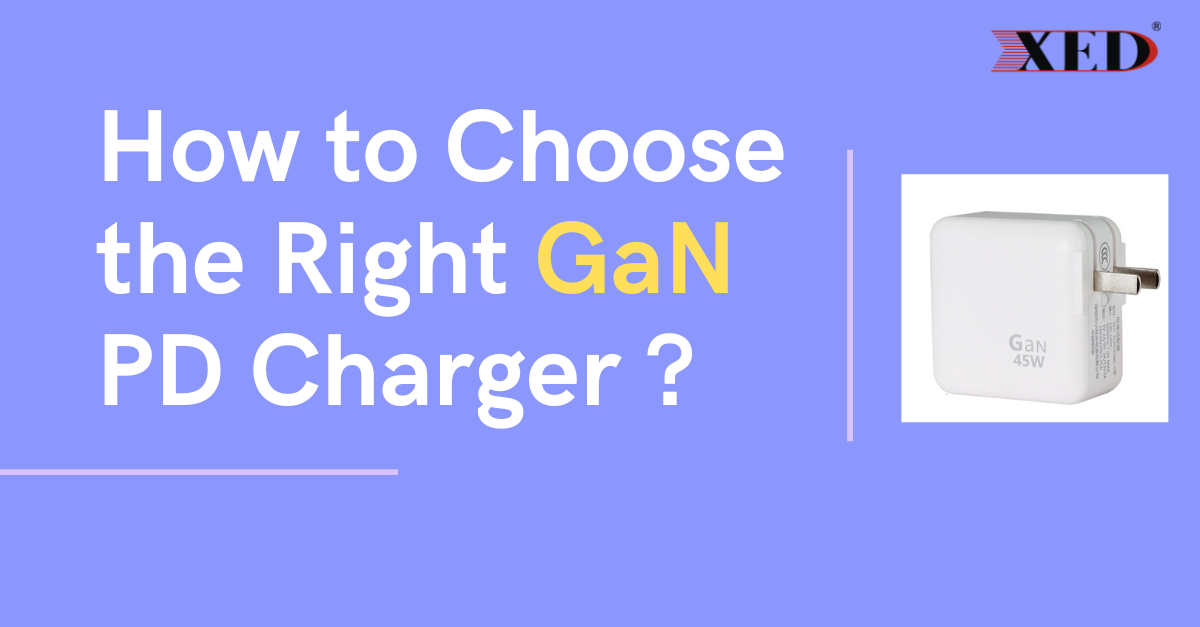
How to Choose the Right GaN PD Charger ?
PoE Switches: What to Know About Stability and Efficiency